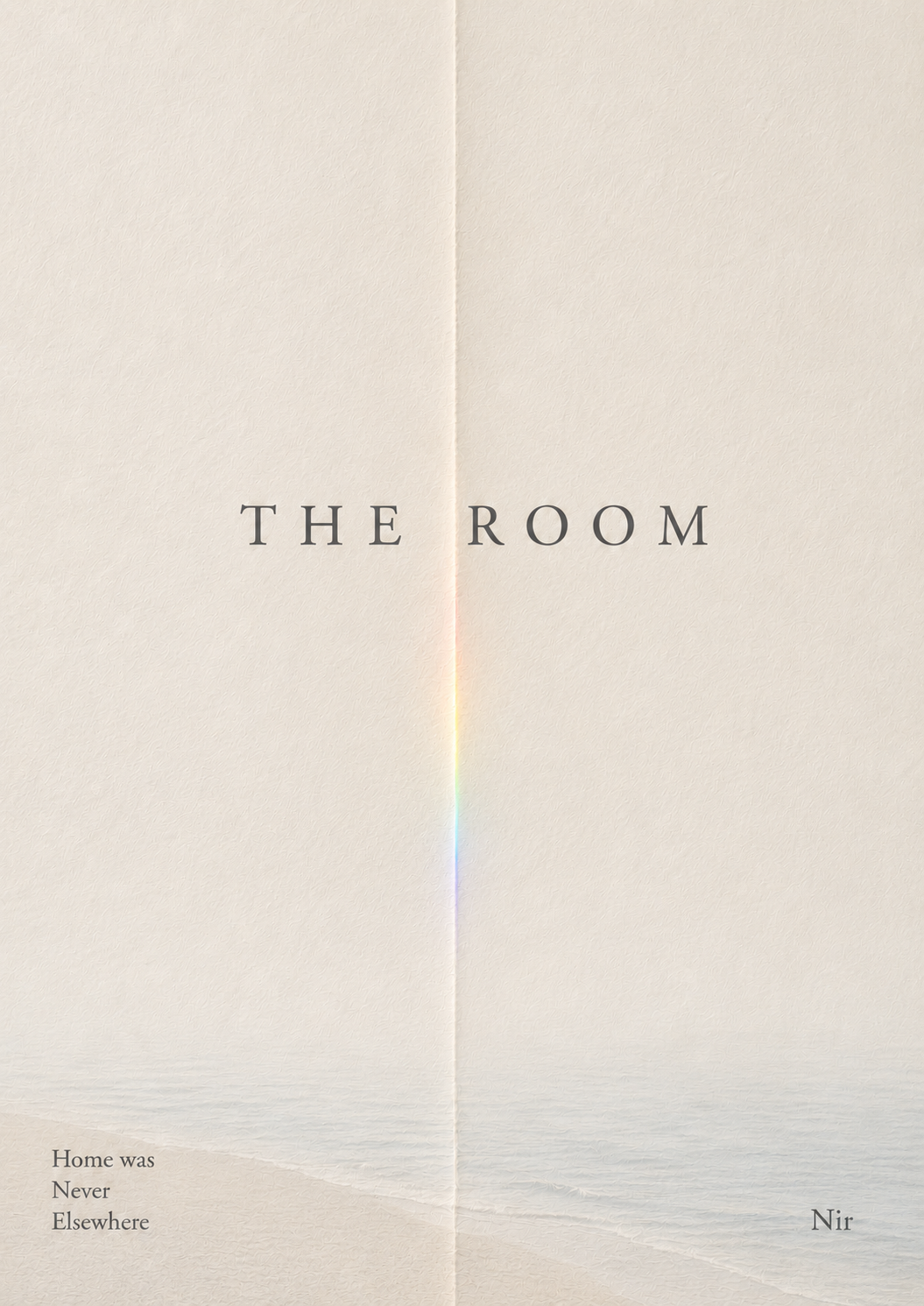

At first, he thought the line belonged to the wall.
It appeared one winter morning above the kettle, thin as a hair and almost the same color as the paint. Steam rose toward it and vanished. When he leaned closer, the line seemed to continue behind the cupboard, across the corner, and along the ceiling.
“Do you see that?” he asked his wife.
She stood beside him, still half asleep, and followed his finger.
“A seam,” she said. “The plasterboards meet there.”
“Where does it begin?”
“At the corner, I suppose.”
“And the corner?”
She looked at him, then at the kettle.
“The water is boiling.”
He poured the coffee. By the time he looked again, the seam had disappeared into the morning light.
But after that he began to see lines everywhere.
The rim that let the cup hold coffee. The edge of the table against the air. The dark shape of his wife’s hair against the window. The instant at which the refrigerator’s hum ended and silence became noticeable. His hand resting on the counter, warm on one side, cold on the other.
None of these things was hidden. Everyone saw them. What no one else seemed to see was that they were all the same clue.
He bought a small black notebook and wrote:
The line does not merely keep two sides apart. It is also the place where they meet.
For several days he said nothing more about it. He went to work, answered messages, washed dishes, listened to his children argue in the back seat. Yet the lines followed him. The curb separated pavement from road and allowed both to have shape. A word rose from the silence around it. A face became visible because it ended somewhere and the world continued.
He began to wonder whether the lines were not inside the world at all.
Perhaps they were what made a world possible.
The second clue was repetition.
Every morning the sun entered through the same window, though never at exactly the same angle. The spoon fell each time he released it. Water heated before it boiled. A seed became a shoot, and the shoot, in time, bore new seeds. When he called someone’s name, an answer, if it came, followed the call. Even silence could be understood only after the asking.
He performed small experiments when no one was watching. He dropped coins from different heights. He timed the kettle. He stood in the hallway switching the light on and off until his youngest child found him and began doing it too.
“What are we testing?” she asked.
“Whether the room keeps its promises.”
She considered this, switched the light off, and ran away laughing.
He reached for the notebook, then let his hand fall.
He tried to imagine the room breaking every promise. The coin might fall, rise, vanish, become a bird. But even impossibility depended on difference. Falling was not rising. A bird was not a coin. Surprise itself required something that could have happened otherwise.
He tried to imagine the absence of every distinction.
There was nothing left to imagine.
A world without rules would not be chaos. Chaos still had differences. Difference itself was already the beginning of order. Without difference, nothing could appear. No world could exist.
That was when he first understood that he was in a room.
Not the kitchen. Not the house. Not the city with its roads and walls. Those were rooms within the room. The larger room did not end at the sea or the sky. Its walls were present wherever anything met what it was not. They ran through every object, every sound, every body, every thought.
He could not stand outside it to see its shape. The attempt itself would appear within his experience and become one more object in the room.
But he could feel its order.
And if there was a room, he thought, perhaps there was a way out.
His wife listened quietly when he told her.
“If the walls are everywhere,” she asked, “what would outside mean?”
“I don’t know yet.”
“And if you found it, how would you know?”
He opened his notebook, then closed it again.
“I don’t know that either.”
At first, only a few friends heard about the room. One of them repeated the idea at dinner. Another wrote about it online. Within a month, strangers were sending him photographs of cracks, shadows, doorways, waves, scars, and horizons.
A musician wrote that a note existed only because it began and ended.
A mason told him that a wall stood because each stone pressed against another.
A nurse described the line on a monitor that changed when a heart stopped beating.
A child sent a drawing of a black page with a white square in the middle. Under it she had written: THIS IS WHERE THE DARKNESS ENDS.
They all saw something.
Somewhere along the way, he began to think they saw pieces and he alone saw the room.
He began speaking about it in libraries, classrooms, and crowded living rooms. Some found the idea obvious once he had said it. Others found it beautiful. A few said they had always felt the walls but had lacked the word. People began asking him questions.
At first, he listened.
Then he began to enjoy being the one who had named it.
“Show us one wall that is not merely an ordinary boundary,” one man said during a public discussion.
“You have just named one,” he answered.
A few people laughed.
He enjoyed that more than he should have.
“And the exit?”
“I am still looking.”
“Then perhaps you have found a metaphor, not a room.”
He did not know why that angered him.
Soon he could listen to a question only long enough to find the mistake in it. When people spoke of grief, love, work, or fear, he translated their lives into evidence for the room. He had begun by noticing that the line belonged to both sides. Somehow he had ended by making it his.
One evening his wife stopped him in the middle of an explanation.
“You don’t look at me anymore,” she said.
“I’m looking at you now.”
“No. You are looking through me for the next clue.”
He tried to answer, but her face did not yield to the sentence he had prepared.
“I am not part of your proof,” she said.
He opened his mouth.
The answer was already there. He could explain that she had misunderstood him. That the room included everyone. That this was precisely what he had been trying to say.
And then he heard himself preparing to turn even this into part of the argument.
He said nothing.
She looked directly into his eyes.
He saw himself there, small and curved in the golden surface of her pupils. He had seen his reflection in her eyes before. He had never wondered who was looking back.
For an instant he understood why a person could never know his own face from within. Another had to return it to him.
The thought came so quickly that his hand moved toward the notebook.
He drew it back.
Because her eyes did more than reflect him.
They refused him.
Behind the image of his own face was a center he could not enter, an entire life appearing from somewhere he would never stand. He had taken his own way of seeing the room to mean that others saw less. Now, looking at her, he understood something harder: there were things in this room that could appear only from where she stood.
The other was not another piece of furniture in his room.
The other was another center of the world.
Much later, after the house had gone quiet, he opened the notebook and wrote:
Look into another’s eyes and you may see yourself. Do not look so eagerly for your reflection that you fail to see the one whose eyes they are.
The next morning his youngest child placed a triangular piece of glass on the windowsill. A second lay beside her. White light crossed the first and opened into color on the opposite wall.
“Look,” she said.
He sat beside her on the floor.
Red, orange, yellow, green, blue, and violet lay across the paint. A moment before, the sunlight had appeared white. Nothing had been added. What had arrived together now appeared apart.
“Do you see the room?” he asked.
She gave him the patient look children reserve for adults who have missed the obvious.
“I see a rainbow.”
He laughed.
She picked up the second prism and held it in the band of color. At first the rainbow bent away. She turned the glass slowly. The colors drew toward one another until, for an instant, they gathered into a small patch of white.
She moved her hand and lost it.
They tried again.
For a while they watched white open into colors and colors gather into white.
It was not proof of anything. He knew that. But the light gave form to what his wife’s gaze had shown him.
The white had not been empty of color. It was the colors carried together.
No color was the whole spectrum.
Yet every color was light.
He held his hand in the band. Red crossed his palm. Blue rested along one finger. For a moment the colors seemed to belong to his skin. But when he followed them backward, they led through the glass, through the window, toward the morning sun.
Perhaps a body was not a room around a private light.
Perhaps it was more like the meeting of light and prism: a boundary at which one world was refracted into a singular perspective. Senses, history, wounds, loves, and memories gave each life its angle.
Perhaps to follow a life inward was not to leave the world behind. It was to find this same world there, appearing from one place.
Partial did not mean false.
To extinguish another life was not to remove a copy of one’s own. It was to remove from the world a color the light could take nowhere else.
His daughter tilted the first prism. Red slipped from his palm to his wrist. Violet climbed the wall. The smallest turn changed where every color fell.
He watched them move.
This movement returned him to time.
Until then, he had treated time as the largest wall of all: the rule that closed the past behind him and kept the future out of reach. He began dismantling clocks to understand it. Inside each one he found only change: a spring unwinding, a crystal vibrating, a wheel turning in relation to another wheel.
He took off his watch for a week. Time did not disappear. Hunger returned. Shadows crossed the floor. His children slept, woke, and carried faces into the morning that were almost, but not quite, the faces they had worn the day before.
Whatever time was, no clock contained it. A clock compared one change with another.
His heartbeat, the swinging pendulum, the turning Earth, and the light crossing the wall could be measured against one another. Each made duration legible through change.
He drew two versions of the room in his notebook. The first was a perfect map containing every wall, object, and possible position. The second was a single line winding through it.
The map had form, but no journey.
The line had a before and an after.
He wrote:
The rules give the room its shape. Time gives the player a path.
This changed the search. An exit could not merely be a place on a map. It had to be reached through a sequence. A door encountered too early might be only a wall. The same words, spoken before a loss and after it, were not the same words. The same hand touching the same face forty years later was not the same touch.
No one could walk his path for him.
Yet he could not make the path alone.
For years he went wherever people told him the room grew thin.
He watched a physicist fill a blackboard with equations until chalk dust whitened her fingertips. Line after line appeared beneath the chalk. At last she stopped where the symbols no longer answered the question she was asking.
Another night he sat in a hospital corridor beside a family waiting for a door to open. At first they spoke. Then they stopped. One of them walked to the vending machine and returned empty-handed. Another kept looking at a phone that had not rung.
He found himself thinking about the door.
On this side of it, they were still the people who had entered the hospital that evening. Whatever came through it would divide their lives into before and after.
His fingers were drawn to the notebook in his coat pocket.
He left it there.
When the door finally opened, one of them reached for another’s hand.
He did not ask what it meant.
He stayed.
He listened to a bell enter silence and leave silence behind it.
He watched the sea erase the border it had drawn in the sand and draw it again a moment later.
Every proposed outside appeared to him from within.
Even the idea of nothing arrived as a thought with a beginning and an end.
He wondered whether the exit would be a place where the rules failed. But if no relation held there, no action could lead to it. A key could not turn. A door could not open. A person could not cross and remain a person.
The rules that seemed to confine him were also what made escape conceivable.
Without a wall, there could be no door.
Without difference, no crossing.
Without time, no way to reach what was not yet here.
He had mistaken distinction for separation. The wall did not merely divide one side from another. It belonged to both. It was the place where they met.
After that, people said he had abandoned the search.
He spoke less. He stopped answering every challenge. He repaired a broken chair, learned to make soup the way his wife liked it, attended weddings and funerals, and sat beside people who had no need for his theory. When someone stood before him, he tried to let that person become more important than the room.
One man who had argued with him for years told him, “You have given up.”
“No,” he said. “I have stopped assuming the exit is elsewhere.”
Some people stopped coming. They had wanted a hidden door, a final formula, a view from outside. Those who remained noticed that he no longer offered certainty. He asked what they saw from where they stood.
The room did not become smaller.
It became inhabitable.
Years passed. His children’s children played with the prisms. The seam above the kettle was plastered, painted, cracked again, and repaired by hands younger than his own. People repeated some of his old sentences, often changing them without noticing.
He grew old enough that strangers spoke loudly to him before learning that his hearing was fine.
By then, the lines he had followed all his life had begun to form a pattern.
From where he stood, the pattern could only take this shape. Others saw the same events from elsewhere: a breakfast, an argument, a birth, a departure, a hand held in a hospital corridor, a question asked too late, an apology offered just in time. In his life, each had left a mark.
For years he had thought the marks must eventually describe a door.
Now he saw something simpler.
They made a path.
No one could walk it for him.
Yet he had not made it alone.
One morning before dawn, he asked his wife to walk with him to the sea.
A wind had blown from the land throughout the night. It met the lowest tide of the season and drove the water farther from shore than anyone in the town remembered. At sunrise, a narrow spine of black stone stood exposed, leading from the beach into the mist.
His wife saw the stones.
They walked together until the water reached them from both sides. There he stopped and turned toward her.
He did not look through her for the path beyond. He looked into her eyes and saw his own face returned to him: old, frightened, unfinished. Behind it he saw the life that had accompanied his without ever becoming his. Another center. Another color. Another path whose ending he would never see.
She placed her hand against his face.
He looked at the stones ahead of them.
Then back at her.
She turned toward the mist. From where she stood, the stones made a slightly different line across the water.
They walked on.
For a while they could follow the same stones. Then the returning tide covered the next one, and they turned back.
Morning light passed through the thinning mist over the water and, for a moment, opened into a faint arc of color.
He saw it.
Beside him, she saw it too.
He did not ask what it meant.
When they reached home, he put the kettle on.
Steam rose toward the seam above it and vanished.
The line was still there.
He poured the coffee into two cups.